
SkilledUp Life is a gold mine for bootstrapped tech founders who want to build scalable digital products and achieve traction without needing to raise equity finance. In this article, I will try my best to help you structure and build a product team using some of our 57,000 SkilledUp Lifers (SkilledUp Life Volunteers).
Pre-requisites
Before you can think of building a product team, I would highly recommend you complete the following:
- Systematically validate the idea by building an Idea Validation team using our SkilledUp Lifers.
- Build an HR team to recruit and onboard the team needed to build your product.
- Have systems, processes and tools in place.
Tip: Do not proceed to product development before systematically validating the idea.
Product Team Structure
We recommend you consider adopting the following structure or a variant of it:
- Product Manager Volunteer.
- UI/UX Designer Volunteers.
- Back-end Developer Volunteers.
- Front-end Developer Volunteers.
- QA Volunteers.
Of course, before you can start, you need to decide on:
- System architecture.
- Technology stack.
- Hosting infrastructure.
These could be achieved during the idea validation or the early stage of the product development. In this case, you might consider adding a System Architect to the Product team.
Our product team for building Version 2 of SkilledUp Life includes:
- Product Owner – in this case, me, the Founder & CEO.
- Product Manager.
- Lead Developer.
- UI/UX Designers.
- Back-end Developers.
- Front-end Developers.
- QA
Other than me and the Lead Developer, everyone is volunteering. In terms of system architecture, we achieved this by using the knowledge of the Lead Developer, me and trusted friends from the Techcelerate Tech Founder network.
You need to write the specifications required for the designers to design and the developers to code. In our case, I write the Specifications. If you are not capable of this task, I strongly suggest you bring on a Business Analyst Volunteer.
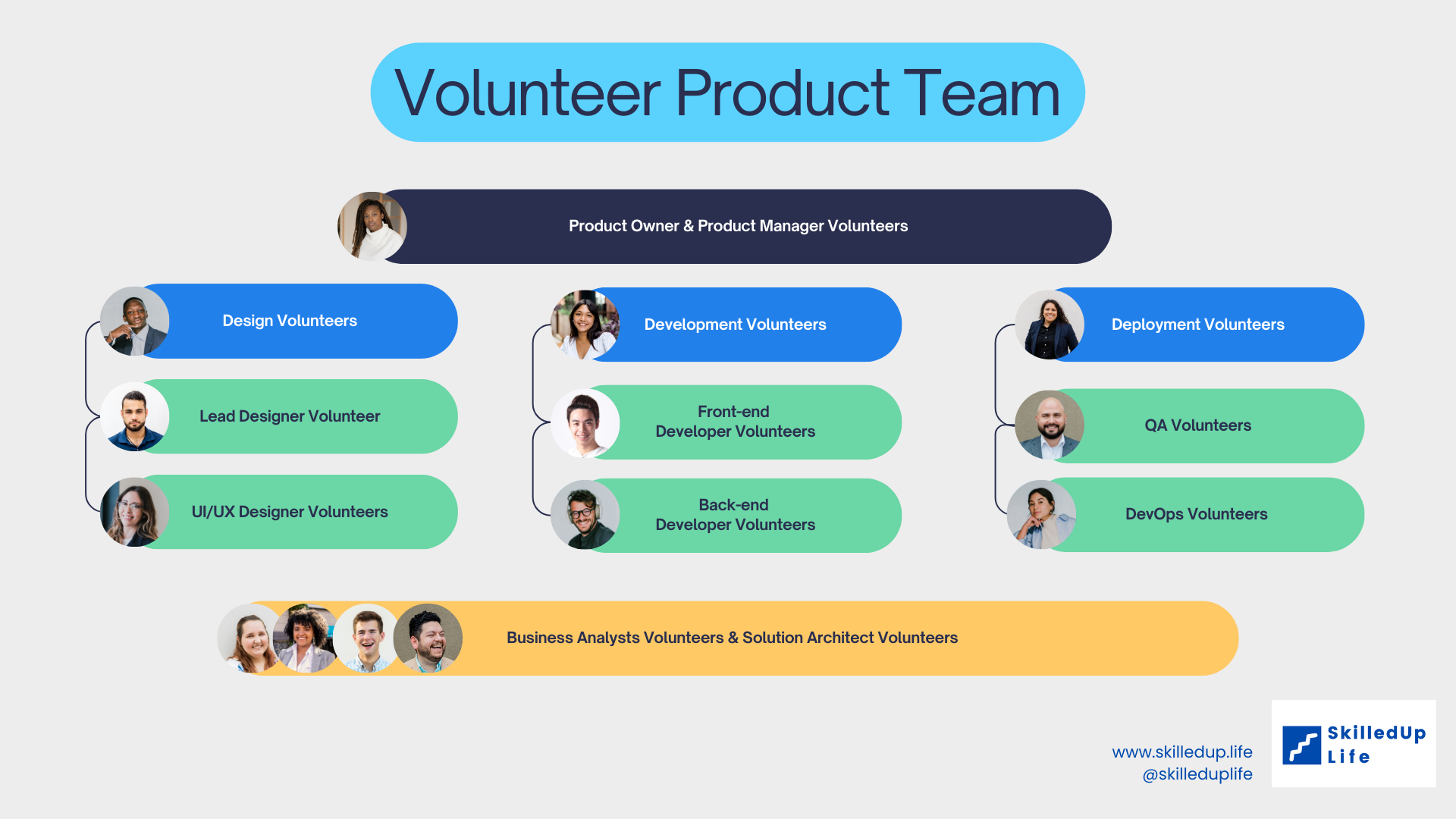
You might also want to consider adding DevOps Volunteers. A full initial team could start to look like:
- Product Owner – Either you, as the sole founder or if you have co-founders, your technical co-founder.
- Business Analyst Volunteers.
- System Architecture Volunteers.
- Product Manager Volunteer.
- UI/UX Designer Volunteers.
- Back-end Developer Volunteers.
- Front-end Developer Volunteers.
- QA Volunteers.
- DevOps Volunteers.
Unsung heroes – HR Volunteers
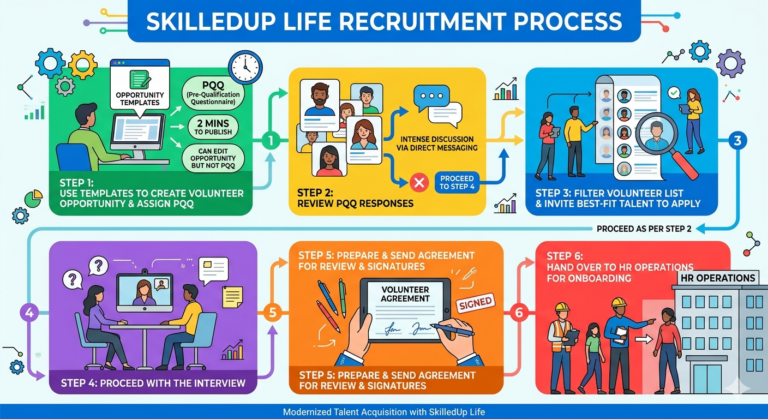
As I recommended earlier, HR Volunteers are the best to unlock the 57,000 skilled talent pool from 146 countries. They are the unsung heroes of your Product team. In our case, we have a dedicated recruiter. I would suggest you consider structuring your HR team into:
- HR Recruitment Volunteers.
- HR Admin Volunteers – helps with onboarding and offboarding.
- HR People Volunteers – helps with ensuring the high performance of your product team.
Of course, the HR team will be generic to building all your teams and not just the product team.
Systems, Processes and Tools
Without systems, processes and tools, you will continue to struggle. Software tools we use:
- Webmail for emails.
- Slack for collaboration.
- Google Drive for documentation.
- GitHub Projects for sprint management.
- Zoom for meetings.
- Figma for design.
We have intentionally kept the number of tools to a bare minimum. We use free versions of the above software tools.
You need to create systems and processes for everything, including but not limited to:
- Role descriptions.
- 13-week plans and targets to achieve.
I\’m still struggling to create the above for each of the roles we have. This means that the onboarding of new team members is not as smooth as it ought to be.
Reducing Intellectual Property (IP) Leakage
Another aspect to consider is reducing the leakage of your Intellectual Property (IP) being created. You need to have strong Volunteer Agreements in place to manage this coupled with the best practices and approaches. Our Essential and Advanced Plans have access to the Advanced Volunteer Agreement template, where we try to minimise IP leakage.
One of the steps you can take is to separate the front-end from the back-end so no developer has access to both codebases. This makes things harder for developers but it\’s an essential safeguard for IP protection. Developers need to set up localhost environments to write code.
You achieve separation by developing an API. This makes everything harder in the short term but in the long term, it allows you to scale your product team much faster.
Select the correct plan
We operate three plans. If you are in the Product Development Stage, the correct plan is either the Advanced or the Essential Plan. Under Advanced Plan, we can guide you not just to build the Product team but also HR and Customer Development Teams.